
Carbon County Busted Booking Facts
A booking at the Carbon County Jail begins the moment someone enters local custody. That is the first fact to hold onto. The Sheriff's Office runs the jail and states it holds people brought in by agencies from across the county. Every intake event creates a record. An identification photograph is made during the same process.
For local custody questions, start with the Sheriff and Jail department. Skip the municipal police pages. Skip the state-prison locator too. A current roster entry tells you one narrow thing: the person appears in the County's displayed table right then. It gives no final charge, no bond decision, and no court outcome. People leave the display for several reasons. The County offers no way to tell which reason applies in a given case.
Each busted booking row carries a fixed set of public fields. The online table is the extent of what Carbon County publishes for that entry, though a fuller record may sit in agency custody.
Carbon County Booking Record Fields
The public interface is limited on purpose. Its real value is the booking number, since that number pinpoints the entry when you file a records request later. Nothing here amounts to a complete booking packet. Carbon County offers no field dictionary for the three hold columns either, so copy those labels word for word rather than reading them as a charge, a warrant, or a release call. A short row stays short.
| Visible field | What the current table shows |
|---|---|
| LAST_NAME and FIRST_NAME | The name as displayed in the current-custody row. |
| BookingNo | A useful identifier for a narrow County record request. |
| Arrival | The field is called Arrival, not arrest time or release time. |
| HOLDS1, HOLDS2, HOLDS3 | Three displayed labels that the County has not publicly defined. |
| Not displayed | No public photo, charge narrative, bond, court date, release information, or custody history. |
A fuller record may exist in agency custody. To reach it, you go through the records process. No photo in the table does not mean no photo was taken. It means the verified roster has no public photo column, no thumbnail, and no person-detail image. Court answers come from the court path. So avoid reading deep meaning into a booking row.
Carbon County Busted Photo Requests
Want a booking photograph, a report, or an older record? Use the county's formal GRAMA route. The Sheriff says booking photos require a GRAMA request and lists a $25 photo charge. That price does not promise any image is public or on hand. Utah classification rules, redaction, and the booking-photo statute still govern what gets released. A narrow request works better than asking an office to dig through a person's history.
- Check the current roster first and save the name, BookingNo, and Arrival field if they are displayed.
- Use the Carbon County GRAMA request page and identify the existing item sought, such as a booking photograph or booking record.
- Give the known name, booking number, and a reasonable booking-date range. Ask for a cost estimate when the scope is broad.
- Wait for the County’s response, which may provide a record, deny or redact it under classification law, direct the request elsewhere, or give a later response date.
The County Clerk wears two hats. One is serving as the appointed records officer for Carbon County. The office sits at 751 E. 100 N., Suite 1100, Price, UT 84501. Call 435-636-3200 or email clerks@carbon.utah.gov. Expect a first reply within ten business days, per the County's stated timeline. The Sheriff posts a set fee schedule: $5 for a police report, $25 for photos, and another $25 for dash-cam or video files. Odd or unusual requests may carry extra terms or costs beyond that list.
The official Sheriff records page lays out the County's booking-photo and fee rules. It documents a request route. It is not a browsable gallery of arrest images.
Two doors, two processes. A police report held by Price or Helper goes through that city's municipal GRAMA form. A booking photo from the Carbon County Jail is different. It follows the Sheriff and County route instead. Start there, not city hall.
Utah Rules for Carbon Booking Photos
Utah's records law goes by the name GRAMA. That is short for the Government Records Access and Management Act. It opens many public records while carving out private, controlled, protected, and confidential classes. One caution: a name in a current bookings table does not unlock every related file at an agency. Carbon County notes that juvenile court files are typically protected. Public court searches hide juvenile, sealed, and expunged matters. So a missing record means access stopped there. It says nothing about a person or a case.
Utah Code §17-72-802 is the recodified booking-photo statute. It covers copies of county jail booking photos and sets removal duties for publish-for-pay sites. A requester seeking a sheriff's copy must sign a non-use statement tied to that type of publication, and GRAMA can shield certain records. The law neither opens every image to the public nor grants a blanket right to delete online material everywhere.
For cases that qualify, the official Utah Courts expungement resource walks through the government-record process and where it stops. Send any correction to the agency holding the source record itself. Some secondary sites offer free takedown routes. Those run on their own track apart from County procedure. And skip any middleman who promises control over an official record for a fee.
Question: Does an expungement wipe a live jail entry right away? No source backs that up. Expungement works on government-record access under its own rules. Current roster status, court displays, and independent publications each move through separate channels.
Finding Carbon County Busted Mugshots
Custody status comes first, photos second. The current table is Carbon's official tool for anyone held in the jail right now. Someone absent from it might be out on release, moved elsewhere, or beyond that snapshot's window. The County offers no release explanations. A person moved into state prison or under Utah Department of Corrections supervision shows up in the state locator instead. Public case filings and their outcomes live in Utah Courts Xchange. Federal and immigration questions each need their own federal systems.
- Search the County’s current roster for a local current-custody question.
- Submit a GRAMA request for a maintained County booking record or photograph that is not available in the roster.
- Use Utah Courts Xchange for a filed public case, hearings, judgments, and disposition.
- Use UDC for state corrections status, then the BOP or ICE locator only if the question concerns federal or immigration custody.
Treat each lookup channel as its own tool. The jail roster answers one question only: who is in custody right now. It is not a court docket. A GRAMA response tells you just whether a booking image exists. Finding nothing in a federal system proves nothing about a Carbon County booking. The county's statewide warrant check, meanwhile, runs on a separate track from all of these custody and court-record routes.
Carbon County Mugshot Access Channels
Start with official sources. They tell you who actually holds a record and what a result can mean. Carbon's public roster has no photo field. A booking image, if one exists, must come through the county GRAMA request process, subject to law and how the record is classified. Everything else sits a step back. KOAL's historical reports and the one verified commercial county landing are secondary materials. They fill in the picture. They never replace the roster or the court record.
| Channel | Custody or record scope | Photo status and access |
|---|---|---|
| Carbon County Jail Bookings | Displayed current county jail custody | No public photo field; search names and save BookingNo. |
| County GRAMA | Existing County-held booking material | Request an existing photo or record; access is evaluated by law. |
| Utah Courts Xchange | Filed public cases and outcomes | Not a booking-photo source. |
| UDC Offender Search | State prison or UDC supervision | Not a County booking-photo screen; use UDC GRAMA for maintained prison material. |
| KOAL monthly archive | Historical local-news-hosted Sheriff summaries | No reviewed photo field; may be incomplete or stale. |
| Mugshots.com Carbon landing | Unofficial secondary county landing | Visible Carbon count was zero at review; never use it as an official record. |
Two secondary sources deserve mention. The KOAL Carbon Jail Bookings archive collects monthly Sheriff-labelled media summaries from a local host. It is not a live official feed. The verified Mugshots.com Carbon County landing is also secondary, and it displayed zero records when checked. No local Carbon coverage could be verified for BustedNewspaper, RecentlyBooked, Arrests.org, or Mugshots.zone. So beware. A generic state page or broad search site is not county coverage, no matter how it looks.
Carbon County Busted Roster Limits
The Carbon County Jail Bookings table is a searchable view of current custody and current bookings. Use the name search and filters. Then read the seven columns as shown: LAST_NAME, FIRST_NAME, BookingNo, Arrival, HOLDS1, HOLDS2, and HOLDS3. You can view and export the current table. It is not an arrest-history database. It is not a release database either. The county has posted no update schedule, no last-updated marker, no 24-hour window, and no rule about how long entries persist after release.
Refresh the page to see its current display. If a name vanishes, that alone does not mean the person was released, transferred, or unbooked. The public table contains no photo, no charge narrative, no bond amount, no court detail, and no person page. Anything deeper takes a different route. The Sheriff's GRAMA process is the record fallback, and Xchange handles court outcomes.
The official current-bookings page appears below, so the narrow format is easy to see.
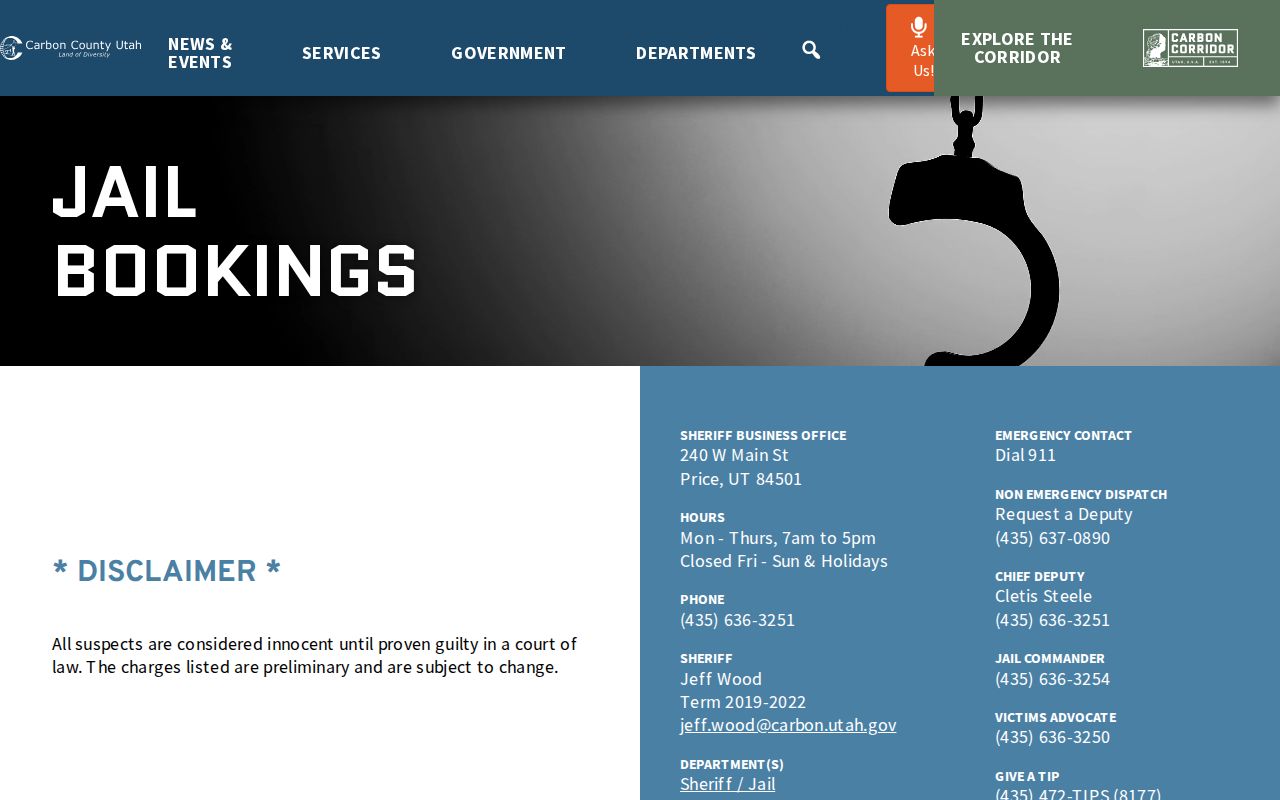
Those sparse columns are a good reason to save the BookingNo for any records request. They are not a reason to guess at facts the county has never published.
Carbon County Booking Feed Windows
Carbon County publishes no separate official feed for today's bookings, the last 24, 48, or 72 hours, the week, releases, or recent arrests. Its one verified official web product is the unwindowed current-custody table. No refresh cadence has been announced. No archive length is stated. That matters if you are trying to find someone booked last night. The current roster may help, but it is not a same-day chronology.
For history, KOAL's month-named archive is the secondary option. Reports generally appear near the start of the following month. They can include arrest date and time, name, agency, incident number, offense language, statute, court, and class. The documents carry a Carbon County Sheriff Office media-arrest heading, yet KOAL is a local-news host. Treat the archive as historical context only. It is not proof of current detention, a complete record, an image source, or a case outcome.
Note: The county publishes no online window or retention rule, so refreshing the roster cannot establish when staff added or removed a row.
Carbon County Sheriff Booking Updates
The Carbon County Sheriff page points to its official Facebook account for current general information. That channel is official. But the county does not call it a booking feed. No booking images, searchable custody list, or archive are promised there. No Sheriff-owned inmate lookup or jail-photo application shows up on the Sheriff page, its related services, or the county sitemap.
Two other tools serve different jobs. Carbon ALERT, also called AlertSense, sends emergency and location-based public-safety alerts. Utah VINE handles custody-status notifications in a corrections context. Neither is a jail roster, a mugshot source, or a court outcome tool. Match the tool to your question. Do not treat social updates, emergency alerts, and official records as the same thing.
Carbon County Busted Records After Prison Transfer
The Utah Department of Corrections Offender Search covers people under UDC supervision. That includes state prison plus probation and parole. It expressly excludes people awaiting trial or not yet sentenced in county jails. Search by first and last name or UDC number. Keep the numbers straight. A UDC number is not a Carbon County BookingNo, and a UDC hit does not prove current county-jail custody.
A UDC result may show identity, offender number, location, assigned facility, release-date or release-type details, and a case-manager contact. It is not a public booking-photo gallery. For a maintained prison photo or other UDC material, the Department points requesters to its public-information GRAMA process, where access can be limited. UDC custody status, a county booking record, and a court outcome remain three separate questions.
Question: What about federal or immigration custody? The BOP Inmate Locator handles federal cases and returns no booking photo. ICE's locator covers current ICE custody and eligible CBP custody. Neither result tells you whether someone sits in Carbon County Jail.
Carbon County Booking Status Compared
A single record can travel through several systems. Reading the right status lane keeps you from treating a preliminary booking as the whole story.
| Situation | Best source | What it cannot establish |
|---|---|---|
| Displayed in local current custody | Carbon County Jail Bookings | Final charge, bond, release reason, or disposition. |
| No longer in the current table | County GRAMA or appropriate agency inquiry | A specific release, transfer, or case result from absence alone. |
| State corrections custody or supervision | UDC Offender Search | Current Carbon jail status or the original booking photo. |
| Filed public case | Utah Courts Xchange | Current jail location or unrestricted sealed records. |
Turn to federal BOP and ICE searches only when those custody systems are truly involved. Their results never substitute for the local roster or the Utah court docket.
Carbon County Court Records After Booking
A booking entry is just the first paperwork. Utah Courts Xchange is the public route to what happens next in CORIS, the state's case system. Filings, hearing dates, judgments, and closed-case outcomes all surface there when a record is public. Cases can appear late, shift as they move, or stay restricted. Sealed, expunged, and juvenile matters never show up in the search at all.
Which court you search depends on the charge. Class B and Class C misdemeanors plus infractions go through Carbon County Justice Court. That court covers the county along with Price, Helper, and Wellington. Class A misdemeanors and felonies land in the Seventh Judicial District. The Justice Court calendar shows Tuesday first appearances at 9:00 a.m., though confirm any specific date with the court or its docket. When you search, enter the person's full name plus any number you have. Keep a booking number separate from a court case number, since the two get confused easily.
Note: A roster row or booking summary is never the final word, so check the public court disposition for how a case actually ended.
Carbon County Busted Records and Privacy
Carbon County draws its privacy lines plainly. Juvenile court files are protected and generally not released, per the County itself. Adult criminal files can also be private or fall under authorized-access and redaction rules. What you see on an official roster is one thing. What a formal request can reach is another. Under GRAMA, the records custodian decides whether an existing record gets released, withheld, or redacted.
Utah Courts draws a similar line. Public Xchange leaves out juvenile, sealed, and expunged matters entirely. Never guess at why a name, photo, or case is missing from a source. If your request is denied, ask for the written classification and the appeal path instead of patching the gap with some unofficial busted listing.
Carbon County Historic Booking Records
How far back can you go? Carbon County posts no stated online retention period for its current roster, and it has no published historical booking-photo archive. Utah's general schedules offer hints. The arrest-record schedule describes a 10-year retention window. The mug-shot schedule calls for permanent retention, with later transfer to an archive. Treat those as leads only, since they promise nothing about whether a specific Carbon record still exists in public form or sits anywhere online.
There is one deeper trail. The State Archives catalog lists Carbon County Sheriff booking files from 1954 forward, arranged by booking number, but marks the series private with a proposed retention still unapproved. For an older record, file a narrow County GRAMA request with a name, approximate date, and booking number if you have it. If the County says files were transferred elsewhere, get the series details and pursue a classification review with the right archive or agency.
Carbon County Busted City Pathways
Price, Helper, and Wellington all run their own municipal police. Yet none of the verified police pages posts a daily arrest log, live booking roster, or booking-photo gallery. So when a bust in one of those cities lands someone in local jail custody, the shared Carbon County table is the current official stop. The split continues on requests. A city police record request covers city-held material, while a county jail booking photo stays a County GRAMA matter.
- Price Busted Mugshots: Price Police reports, County jail custody, and the city GRAMA form.
- Helper Busted Mugshots: Helper Police records, limited office hours, and shared dispatch.
- Wellington Busted Mugshots: City and dispatch contacts, written records requests, and County custody.
KOAL's monthly summaries sometimes carry PCPD, HPD, and WPD agency labels. Read them as local-news history for all three cities. They are not separate municipal custody databases.
Wellington Busted Booking Context
Wellington's March 2026 public minutes took up three police-service models: an independent department, a Sheriff contract, or a hybrid. The same meeting recorded the appointment of Chief Kevin Saccomano. None of that settles whether a contract exists now or a booking system differs. It does explain why the current official Wellington police or dispatch contact, plus the shared County roster, beat any assumption about a permanent policing setup.
The city has no verified public booking feed or photo page. Need a non-emergency line fast? Use Carbon County Dispatch. For a city-held record, write to Wellington City Hall or its records officer. Describe the existing record, and confirm the current recipient, cost, and timing. Anything from the county jail goes through the Carbon County GRAMA process.